


Quick answer
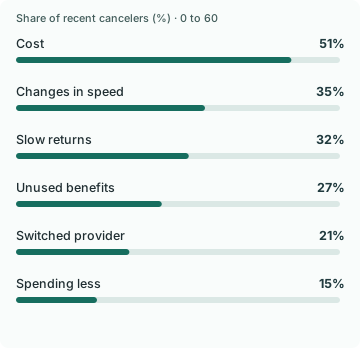
In DHL’s 2026 survey, 40% of shoppers reported paying for a delivery or returns subscription. Among respondents who had recently canceled one, 51% cited cost, 35% cited changes in delivery speed and 32% cited a slow returns process. In the separate business survey, 38% of B2C respondents already offered a paid logistics subscription and 39% planned to.
Key findings and sources
Premium logistics adoption differs across age groups
In DHL’s 2026 shopper survey, 50% of Millennial respondents and 22% of Baby Boomer respondents reported paying for a delivery or returns subscription. That is a 28-point difference and a ratio of 2.27 from the published percentages.
DHL, 2026 E-Commerce Trends Report
Age groups in a 29-market online-shopper survey. Subtract and divide the reported percentages for the two age groups.
B2C delivery memberships trail B2B in the survey
DHL’s 2026 business survey found that 38% of B2C respondents and 58% of B2B respondents already offered paid logistics subscriptions, a 20-point difference. A separate 39% of B2C respondents said they planned to offer one.
DHL, 2026 E-Commerce Trends Report
B2C and B2B subgroups of surveyed ecommerce businesses. Subtract the two current-offer percentages. Report B2C plans as a separate response.
Cost leads cancellation, but speed and returns are close together
Among DHL’s 2026 survey respondents who had recently canceled a paid delivery or returns subscription, 51% cited cost, 35% cited changes in delivery speed and 32% cited slow returns. Cost exceeded speed by 16 points. Speed exceeded slow returns by three points.
DHL, 2026 E-Commerce Trends Report
Recent cancelers answering DHL’s cancellation-reasons question. Multiple reasons can apply. Subtract published response shares within that question.
Flexibility appears more often as an offer than as a reason to buy
In DHL’s separate 2026 survey questions, 45% of responding businesses offering paid logistics cited flexibility among the benefits they provided, while 28% of responding subscribers cited it as a reason for having the subscription. The difference was 17 points.
DHL, 2026 E-Commerce Trends Report
Two different groups and questions. The comparison is directional. Subtract the published shopper response share from the published business response share.
Compare the results
Start with shoppers who could actually use the benefit
Someone who orders a refill every month can value waived postage without changing their buying habits. A shopper buying a wedding gift may need one reliable delivery and have little reason to subscribe. DHL’s adoption figures put a number on how much the appetite can vary. Half of Millennial respondents reported a paid delivery or returns subscription, versus 22% of Baby Boomers. The survey describes existing memberships across many retailers. Use order frequency and actual shipping choices to find promising buyers at your store.
The merchant breakdown points to an equally important difference. In DHL’s business sample, 38% of B2C firms said they offered paid logistics and 39% said they planned to. The rate already offering it reached 62% among medium enterprises and fell to 29% among sole traders. That 33-point gap is a reason to check shipping economics before comparing your offer to a marketplace’s. One store absorbs the cost of its own benefits. A marketplace can spread them across orders the shopper would place with different sellers.
Put savings and reliability through the same test
In the benefits table, preferential pricing was cited by 55% of shoppers with a logistics subscription. Flexibility was cited by 28%, while 45% of businesses that answered the separate benefits question said they offered it. The 17-point difference compares two questions, so it tells you which promise to test in customer conversations. Ask what the shopper would save on their normal basket and whether they can identify the orders the benefit covers.
The cancellation answers explain why the checkout offer and the operating promise need to agree. Cost led at 51%, but changes in speed and slow returns were only three points apart at 35% and 32%. If you can meet the promised delivery window but leave a return unacknowledged for a week, the benefit can still disappoint a buyer. Compare paid members with repeat customers of similar order frequency. Look at actual delivery-window misses, time to acknowledge returns, fee refunds and support contacts alongside uptake.
Use the fee to price a service you can keep
Before adding a paid option to checkout, calculate the member fee plus any incremental order contribution, less shipping subsidies, incremental returns handling, service costs and waived standard shipping revenue. Use a conservative estimate of additional orders, because people who sign up may already buy frequently. Run the same calculation for heavy users and hard-to-serve postal codes. The average member can look profitable while the most enthusiastic members create the greatest loss.
Test the offer with repeat shoppers who can reasonably save money and whose delivery lanes can support it. Keep the standard service terms clear at checkout. A buyer asking whether a Saturday order arrives by Tuesday needs the exact cutoff, destination and delivery window before hearing about membership. For a time-critical purchase, offer a reliable one-time upgrade where available. If you cannot verify the promise for that destination, give the range you can substantiate and leave the subscription out of that conversation.
Study data
| Measure | Value | Context |
|---|---|---|
| Global premium logistics subscribers | 40% | Global premium logistics subscribers |
| Gen Z premium logistics subscribers | 48% | Gen Z premium logistics subscribers |
| Millennial premium logistics subscribers | 50% | Millennial premium logistics subscribers |
| Gen X premium logistics subscribers | 37% | Gen X premium logistics subscribers |
| Baby boomer premium logistics subscribers | 22% | Baby boomer premium logistics subscribers |
| All businesses offering paid logistics | 53% | All businesses offering paid logistics |
| B2C businesses offering paid logistics | 38% | B2C businesses offering paid logistics |
| B2C businesses planning paid logistics | 39% | B2C businesses planning paid logistics |
| B2B businesses offering paid logistics | 58% | B2B businesses offering paid logistics |
| Sole traders offering paid logistics | 29% | Sole traders offering paid logistics |
| Medium businesses offering paid logistics | 62% | Medium businesses offering paid logistics |
| Preferential pricing cited by subscribers | 55% | Preferential pricing cited by subscribers |
| Priority service cited by subscribers | 39% | Priority service cited by subscribers |
| Flexibility cited by subscribers | 28% | Flexibility cited by subscribers |
| Preferential pricing offered by businesses | 55% | Preferential pricing offered by businesses |
| Priority service offered by businesses | 41% | Priority service offered by businesses |
| Flexibility offered by businesses | 45% | Flexibility offered by businesses |
| Cost prompted cancellation | 51% | Cost prompted cancellation |
| Delivery speed prompted cancellation | 35% | Delivery speed prompted cancellation |
| Slow returns prompted cancellation | 32% | Slow returns prompted cancellation |
| Unused perks prompted cancellation | 27% | Unused perks prompted cancellation |
| Provider switch prompted cancellation | 21% | Provider switch prompted cancellation |
| Reducing spending prompted cancellation | 15% | Reducing spending prompted cancellation |
What changes when you compare the figures
| Comparison | Result | Calculation |
|---|---|---|
| Millennial versus baby boomer adoption gap | 28 percentage points | = 50 - 22 |
| Millennial versus baby boomer adoption ratio | 2.27 times | = 50 / 22 |
| B2B versus B2C current offer gap | 20 percentage points | = 58 - 38 |
| Medium business versus sole trader offer gap | 33 percentage points | = 62 - 29 |
| Cost versus changed delivery speed as a cancellation reason | 16 percentage points | = 51 - 35 |
| Changed delivery speed versus slow returns as a cancellation reason | 3 percentage points | = 35 - 32 |
| Reported flexibility offer versus shopper reason gap | 17 percentage points | = 45 - 28 |
Methodology and sources
We transcribed DHL’s shopper and business tables on pages 23 and 24. The overall survey included 29,000 online shoppers in 29 markets and 5,800 businesses in 28 markets. We subtract displayed whole percentages to compute point differences and compare selected rates as ratios. Responses to benefits and cancellation items can overlap. Those rates use narrower question bases than the global survey, and company and shopper responses cannot be matched to one another. The report does not establish the economics of a single brand’s subscription.
Download the source data (CSV)
Download the calculations (CSV)
Related reading
Delivery option statistics and checkout abandonment
Cross-border checkout statistics for duties, delivery and buyer trust
Free shipping checkout statistics and how to test a minimum spend
Sustainable delivery checkout statistics and the price trade-off
Sources and definitions
DHL, 2026 E-Commerce Trends Report
The source data includes the population, period, denominator and limitations for every figure.