


Quick answer
In AlixPartners’ 2026 survey of 1,000 US consumers, 70% said free shipping greatly affected their ordering decision and 24% said it somewhat affected it. A separate DHL question combined fast and free delivery with easy returns. In that table, 21 of 29 country rows reached at least 90%. Neither measure identifies a profitable minimum spend.
AlixPartners, Great Expectations: 2026 Home Delivery Survey · DHL, 2026 E-Commerce Trends Report
Key findings and sources
Ninety-four percent reported some free-shipping influence
AlixPartners’ 2026 online survey of 1,000 US consumers found that 70% said free shipping greatly affected ordering and 24% said it somewhat affected ordering. Together they represent 94% of respondents; this measures stated influence rather than conversion lift.
AlixPartners, Great Expectations: 2026 Home Delivery Survey
DHL’s global measure combines three priorities
DHL’s 2026 Delivery and Returns Trends reported that 92% of global shoppers prioritized fast, free delivery and easy returns together. The wording does not isolate the effect of free delivery alone.
DHL, 2026 E-Commerce Trends Report · group.dhl.com
Twenty-one of 29 country rows reached at least 90 percent
An original count of DHL’s 29 country rows found that 21 reached 90% or more on the combined fast, free delivery and easy returns question. Each published country row counts once. Global and regional aggregate rows were excluded.
DHL, 2026 E-Commerce Trends Report
The published country range was 12 points
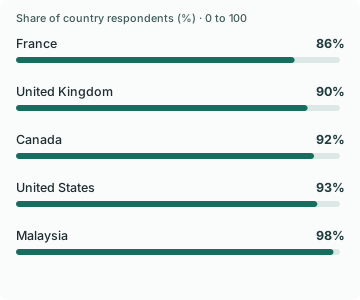
DHL’s 2026 country table ranged from 86% in France to 98% in Malaysia on its combined fast, free delivery and easy returns priority question. The 12-point range describes published country estimates, not statistical significance.
DHL, 2026 E-Commerce Trends Report
Nine country rows reached 95 percent on the combined delivery-and-returns item
Convo Rescue counted nine of 29 DHL 2026 country rows at or above 95% on the fast, free delivery and easy returns statement, versus 21 rows at or above 90%. These counts cannot isolate free shipping or predict the effect of a spend threshold.
DHL, 2026 E-Commerce Trends Report
About three in four US respondents reporting any free-shipping influence chose greatly
In AlixPartners’ 2026 home delivery survey, 70% said free shipping greatly affected ordering and 24% selected somewhat. The great response was 74.5% of the respondents in the two influence categories, using rounded figures.
AlixPartners, Great Expectations: 2026 Home Delivery Survey
US consumer responses in AlixPartners’ 2026 survey; unit is a stated ordering response. Divide the great response by the sum of great and somewhat responses.
Four high-priority country rows scored below 80 percent on a separate delivery choice question
In DHL’s 2026 table, four of nine countries with at least 95% prioritizing fast, free delivery and easy returns fell below 80% on stated abandonment without preferred delivery. The comparison describes two questions in matched country rows.
DHL, 2026 E-Commerce Trends Report
29 published DHL country rows, unweighted by population. Filter on the rounded combined-priority response and count qualifying rows below 80% in the separate delivery column.
Compare the results
Two surveys make different points about free shipping
AlixPartners asked 1,000 US consumers about ordering an item for delivery. In its 2026 chart, 70% said free shipping greatly affected their ordering decision, 24% said it somewhat affected it and 6% said it was not a consideration. Adding the first two answers gives 94%. That is a stated influence, not the share of shoppers who would otherwise leave.
DHL published a different question: whether shoppers prioritize fast, free delivery and easy returns when shopping online. Its global answer was 92%. This wording matters. One cannot isolate the contribution of free delivery, fast delivery or easy returns from the bundled answer. The two headline percentages should not be averaged or treated as separate estimates of the same event.
Reading all 29 country rows adds a view that the global figure alone does not provide. The lowest published row was France at 86% and the highest was Malaysia at 98%, a 12-point spread. Twenty-one of the 29 countries reached at least 90%, and the middle country rate was 92%. These are summaries of published country estimates with each market counted once, not estimates of the number of consumers worldwide.
A minimum spend has more than one way to change margin
A free shipping threshold can change the probability a cart completes, the merchandise in an order, the shipping charge collected and fulfillment expense. Those outcomes should stay separate. A shopper who was already going to buy may simply stop paying for delivery. A shopper below the threshold may add an item, leave, or complete the smaller cart and pay the fee. A high survey response does not identify how often each happens.
Consider a hypothetical cart that would already complete with a $6 shipping charge. If a threshold induces $15 of extra merchandise at a 40% contribution rate, that merchandise adds $6 before shipping. Waiving the $6 charge then leaves no incremental contribution, assuming carrier cost and other costs stay unchanged. If the additional item changes package size or shipping cost, it can turn that illustrative break-even into a loss. If the offer recovers a purchase that would not otherwise occur, the comparison changes again.
Build the test around eligible carts. Track merchandise contribution, shipping revenue, carrier expense and orders per assigned cart. Consider refunds and returns on the same observation schedule. An increase in average order value can coexist with flat contribution once the shipping subsidy is included.
Make the qualification rule answerable before payment
A buyer near a free shipping minimum needs to know what counts toward it. Check the calculation on the actual cart after discounts, and whether delivery location, service level or excluded items change the answer. A threshold message is useful when it explains the real payable total. It becomes another source of friction if the promise changes at checkout without an explanation.
Test a cart clearly below the threshold, one just above it, and one where a discount puts it back below. Repeat with a destination that uses different delivery terms. Document where the rule first appears and where the total changes. The person answering a checkout question should be able to explain the applicable amount and service without guessing.
When the data are available, separate shoppers who already qualified from shoppers close enough to respond to the threshold. The right business decision depends on incremental completed orders and contribution, not on the number of people who prefer a free option in a survey. Report those outcomes alongside what was shown to each eligible cart.
The median country row cannot set your free shipping threshold
Nine of the 29 country rows in DHL’s published table were at least 95% for the combined fast delivery, free delivery and easy returns statement. That is 31.03% of the rows, compared with 72.41% reaching at least 90%. The middle country was 92%. A five-point cutoff changes the number of markets counted from 21 to nine. The comparison describes a rounded, combined survey statement, so it cannot tell you how many people in any country will add an item to qualify for free shipping.
For a useful threshold test, start with carts close enough to the threshold to make the proposed change credible. Someone with $4 left to reach it faces a different choice from a shopper who would need to add an entire second product. Show what qualifies and keep the final service promise visible. If a lightweight extra and a bulky extra both cross the same threshold, track them separately when their shipping costs differ.
Check the commercial outcome for all eligible sessions, including the shoppers who see the prompt and leave. Record contribution after product cost, the shipping amount charged or waived, and changes in fulfillment cost. A higher average order value among buyers can coexist with worse total contribution if enough eligible visitors leave without ordering. The country comparison makes the strength of the stated preference visible. It is a starting point for the experiment, and the store’s checkout comparison must decide whether its offer works.
How strongly free shipping matters depends on the question
In AlixPartners’ 2026 US survey, 70% said free shipping greatly affects an ordering decision, 24% said it affects the decision somewhat, and 6% said it is not a consideration. Re-expressing the first response within the 94% reporting any influence gives about 74.5%. The conditional figure describes the intensity of a stated preference, without an estimate of what any store would gain by waiving a fee.
DHL’s international table helps show why a different question can produce a different signal. Of nine country rows that reached 95% on the combined priority of fast and free delivery and easy returns, four fell below 80% on the separate question about leaving when preferred delivery options are missing. The four were India, Malaysia, Nigeria, and South Africa. Both measures can be true in the same market. They capture different things, and the row-level match does not give an individual shopper’s response to both questions.
Decide what a threshold has to earn back
A free-shipping minimum can move an order upward, waive a charge on an order that would have happened anyway, or deter a buyer below the threshold. A worked merchant scenario makes the trade-off visible. If the current customer pays a $6 fee and every extra merchandise dollar contributes 30 cents, the basket needs $20 more merchandise to replace the fee. If qualifying for the new basket size also adds $2 of handling cost, the required extra merchandise rises to about $26.67. Use the actual contribution margin after relevant returns and handling rather than the markup printed in the catalog.
In a test, keep eligible carts below, near, and above the minimum in the same allocation and read each group separately. In the near-threshold group, check incremental items and shipping costs together. Above the threshold, watch for a subsidy paid on otherwise identical purchases. If the business never charged shipping on those orders in the first place, the $6 term is zero and the comparison must use the real change in fulfillment cost. Measure contribution per eligible session to decide whether the policy is worth keeping.
Study data
| Measure | Value | Context |
|---|---|---|
| Prioritize fast, free delivery and easy returns: Argentina | 97% | Prioritize fast, free delivery and easy returns: Argentina |
| Prioritize fast, free delivery and easy returns: Australia | 91% | Prioritize fast, free delivery and easy returns: Australia |
| Prioritize fast, free delivery and easy returns: Austria | 91% | Prioritize fast, free delivery and easy returns: Austria |
| Prioritize fast, free delivery and easy returns: Belgium | 87% | Prioritize fast, free delivery and easy returns: Belgium |
| Prioritize fast, free delivery and easy returns: Brazil | 96% | Prioritize fast, free delivery and easy returns: Brazil |
| Prioritize fast, free delivery and easy returns: Canada | 92% | Prioritize fast, free delivery and easy returns: Canada |
| Prioritize fast, free delivery and easy returns: China | 87% | Prioritize fast, free delivery and easy returns: China |
| Prioritize fast, free delivery and easy returns: Czech Republic | 90% | Prioritize fast, free delivery and easy returns: Czech Republic |
| Prioritize fast, free delivery and easy returns: Denmark | 89% | Prioritize fast, free delivery and easy returns: Denmark |
| Prioritize fast, free delivery and easy returns: France | 86% | Prioritize fast, free delivery and easy returns: France |
| Prioritize fast, free delivery and easy returns: Germany | 88% | Prioritize fast, free delivery and easy returns: Germany |
| Prioritize fast, free delivery and easy returns: India | 95% | Prioritize fast, free delivery and easy returns: India |
| Prioritize fast, free delivery and easy returns: Italy | 91% | Prioritize fast, free delivery and easy returns: Italy |
| Prioritize fast, free delivery and easy returns: Malaysia | 98% | Prioritize fast, free delivery and easy returns: Malaysia |
| Prioritize fast, free delivery and easy returns: Morocco | 93% | Prioritize fast, free delivery and easy returns: Morocco |
| Prioritize fast, free delivery and easy returns: Netherlands | 87% | Prioritize fast, free delivery and easy returns: Netherlands |
| Prioritize fast, free delivery and easy returns: Nigeria | 97% | Prioritize fast, free delivery and easy returns: Nigeria |
| Prioritize fast, free delivery and easy returns: Poland | 92% | Prioritize fast, free delivery and easy returns: Poland |
| Prioritize fast, free delivery and easy returns: Portugal | 97% | Prioritize fast, free delivery and easy returns: Portugal |
| Prioritize fast, free delivery and easy returns: Saudi Arabia | 94% | Prioritize fast, free delivery and easy returns: Saudi Arabia |
| Prioritize fast, free delivery and easy returns: South Africa | 96% | Prioritize fast, free delivery and easy returns: South Africa |
| Prioritize fast, free delivery and easy returns: Spain | 95% | Prioritize fast, free delivery and easy returns: Spain |
| Prioritize fast, free delivery and easy returns: Sweden | 88% | Prioritize fast, free delivery and easy returns: Sweden |
| Prioritize fast, free delivery and easy returns: Switzerland | 89% | Prioritize fast, free delivery and easy returns: Switzerland |
| Prioritize fast, free delivery and easy returns: Thailand | 90% | Prioritize fast, free delivery and easy returns: Thailand |
| Prioritize fast, free delivery and easy returns: Türkiye | 95% | Prioritize fast, free delivery and easy returns: Türkiye |
| Prioritize fast, free delivery and easy returns: UAE | 92% | Prioritize fast, free delivery and easy returns: UAE |
| Prioritize fast, free delivery and easy returns: UK | 90% | Prioritize fast, free delivery and easy returns: UK |
| Prioritize fast, free delivery and easy returns: USA | 93% | Prioritize fast, free delivery and easy returns: USA |
| Global prioritization of fast, free delivery and easy returns | 92% | Global prioritization of fast, free delivery and easy returns |
| Measure | Value | Context |
|---|---|---|
| Free shipping greatly impacts the ordering decision | 70% | Free shipping greatly impacts the ordering decision |
| Free shipping somewhat impacts the ordering decision | 24% | Free shipping somewhat impacts the ordering decision |
| Free shipping is not a consideration | 6% | Free shipping is not a consideration |
| Measure | Value | Context |
|---|---|---|
| High-priority country rows below 80 percent on the separate delivery option question | 4 country rows | Published source value |
What changes when you compare the figures
| Comparison | Result | Calculation |
|---|---|---|
| Share of published DHL country rows at or above 90% | 72.41% | = 21 / 29 * 100 |
| Range across the DHL country rows for the combined priority | 12 percentage points | = 98 - 86 |
| Unweighted average of the 29 rounded DHL country rows | 91.93% | = 2666 / 29 |
| Any effect of free shipping on ordering in the AlixPartners categories | 94% | = 70 + 24 |
| Hypothetical extra contribution from $15 of added merchandise at 40% | $6.00 | = 15 * 40 / 100 |
| Hypothetical incremental contribution after forfeiting a $6 shipping charge | $0.00 | = 6 - 6 |
| Share of country rows at or above 95 percent on the combined item | 31.0345% | = 9 / 29 * 100 |
| Country rows dropped when the cutoff rises from 90 to 95 percent | 12 country rows | = 21 - 9 |
| Share of country rows between the two cutoffs | 41.3793% | = (21 - 9) / 29 * 100 |
| Share of affected AlixPartners respondents selecting greatly | 74.4681 % of respondents reporting influence | = 70 / (70 + 24) * 100 |
| High-priority DHL rows below 80 percent on the missing delivery item | 44.4444 % of high-priority country rows | = 4 / 9 * 100 |
| Worked scenario, additional merchandise required to replace a six dollar fee at 30 percent margin | $20.00 | = 6 / 0.30 |
| Worked scenario, additional merchandise required after a two dollar handling cost | $26.67 | = (6 + 2) / 0.30 |
Methodology and sources
We transcribed the first column of all 29 DHL country rows and excluded the GLOBAL, Europe and generation rows from original country calculations. We counted the country rows at or above 90%, sorted the 29 rates to identify the middle row, and compared their maximum and minimum. Each country counts once in the calculations, with no weighting by population. Separately, we transcribed the three consumer categories in the AlixPartners chart. The worked threshold examples are hypothetical contribution arithmetic, not observations from either survey.
Download the source data (CSV)
Download the calculations (CSV)
Related reading
Delivery option statistics and checkout abandonment
Cross-border checkout statistics for duties, delivery and buyer trust
Sustainable delivery checkout statistics and the price trade-off
Sources and definitions
DHL, 2026 Delivery and Returns Trends
AlixPartners, Great Expectations: 2026 Home Delivery Survey
The source data includes the population, period, denominator and limitations for every figure.