


Quick answer
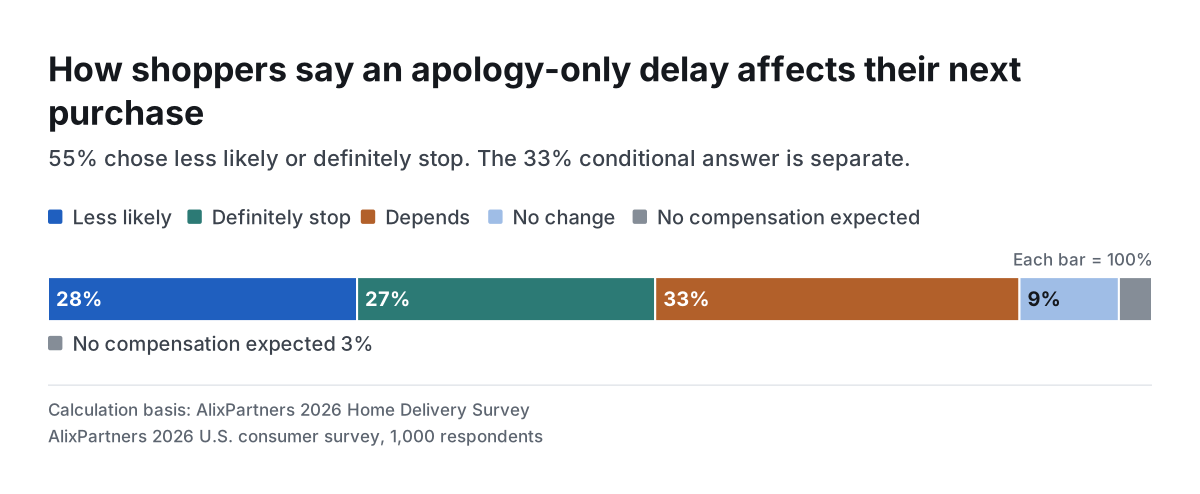
In AlixPartners’ 2026 U.S. consumer survey, 55% said a late delivery followed only by an apology would make them less likely to buy again or definitely stop buying. Another 33% said it might affect their decision depending on the situation. The 55% combines two separate answers, 28% less likely and 27% definitely stop, from a question about what shoppers would do.
Key findings and sources
Apology-only repurchase risk
55% of surveyed U.S. consumers said they would be less likely to buy again or would definitely stop buying after a late delivery followed only by an apology.
AlixPartners 2026 Home Delivery Survey
AlixPartners 2026 survey, n=1,000 U.S. consumers; stated intent. Add 28% and 27% from the same response distribution.
Conditional versus definite risk
33% said it might affect buying depending on the situation, and 27% said they would definitely stop buying.
AlixPartners 2026 Home Delivery Survey
Same U.S. consumer survey and hypothetical scenario. Two published response shares kept separate.
Stop-buying share inside the firmly negative group
In the 2026 AlixPartners U.S. survey, about 49% of the firmly negative answer share came from consumers who said they would definitely stop buying.
AlixPartners 2026 Home Delivery Survey
AlixPartners 2026 U.S. apology-only question; rounded source percentages. Divide 27 by the 55 percentage points of firmly negative answers.
Value of an explanation
AlixPartners separately reported that 90% of consumers rated updated dates and clear explanations as important when deliveries are late.
AlixPartners 2026 Home Delivery Survey
2026 U.S. consumers; a separate survey item. Published share, with no inference about the overlap between questions.
Compare the results
How shoppers say an apology-only delay affects their next purchase
55% chose less likely or definitely stop. The 33% conditional answer is separate.
What an apology leaves unanswered
A shopper who already paid is waiting to decide whether the order will still work. A sincere apology helps, but the message also needs to address timing. If a new date is confirmed, state it. If the carrier has only opened an investigation, tell the shopper what you know and when you will check again.
Keep the 55% and 88% separate when you cite the survey. The larger figure includes 33% who left their answer open. Treating everyone in that group as a lost customer overstates the evidence and makes it harder to decide who needs help first.
Triage by what the delay changes
The same delay has different consequences for a replenishment order and a gift. If the shopper tells you it is for Friday, check whether any existing option can still meet that deadline. If the only verified option arrives next week, say so before the shopper rearranges plans around another estimate.
When there is no new date, give an update time your team can meet and explain what you are waiting for. If a verified replacement or cancellation policy applies, make it easy to take that option. For an ambiguous carrier status, keep the conversation with the team that can check it rather than passing the shopper around.
Measure whether the response helped
Track promised date misses separately from confirmed losses. Among delayed orders, compare the share that received a proactive update, how often a second contact was needed and later repeat purchase for shoppers with similar order and delay profiles.
Avoid pricing compensation off a survey answer. The study tells you an apology alone can leave a material problem unresolved. It does not compare store credits, shipping refunds, replacement or outreach channels.
Study data
| Measure | Value | Context |
|---|---|---|
| Consumer sample | 1,000 people | Published source value |
| Executive sample | 100 people | Published source value |
| Minimum annual revenue of executive respondents’ companies | 100 USD millions | Published source value |
| Updated delivery dates and clear explanations are important | 90% | Published source value |
| Might affect buying depending on the situation | 33% | Published source value |
| Less likely to buy again | 28% | Published source value |
| Definitely stop buying | 27% | Published source value |
| Would not change buying decision | 9% | Published source value |
| Do not expect compensation | 3% | Published source value |
| At least some stated repurchase risk | 88% | Published source value |
| Late delivery survey edition | 2,026 year | Published source value |
| Firmly negative response share, calculated | 55% | Original reanalysis of 28% and 27%; both belong to the same question. |
What changes when you compare the figures
| Comparison | Result | Calculation |
|---|---|---|
| Firmly negative group | 55% | = 28+27 |
| Risk including conditional response | 88% | = 28+27+33 |
| Other two answers | 12% | = 9+3 |
| Definitely stop within firmly negative answers | 49.09% | = 27/55*100 |
| Firmly negative share versus conditional share | 22 percentage points | = 55-33 |
Methodology and sources
Reanalysis adds or divides mutually exclusive response shares from PDF p. 5. The separately reported importance of explanations and updated dates is a different question. The executive sample size is disclosed for provenance and is excluded from consumer calculations.
Download the source data (CSV)
Download the calculations (CSV)
Download the citation notes (CSV)
Related reading
Split Shipment Statistics and What Merchants Prioritize
Delivery option statistics and checkout abandonment
Cross-border checkout statistics for duties, delivery and buyer trust
Free shipping checkout statistics and how to test a minimum spend
Sources and definitions
AlixPartners 2026 Home Delivery Survey
The source data includes the population, period, denominator and limitations for every figure.